

Venue Guide
This guide assists venues in understanding what information to request and verify when laser effects are proposed within an event environment, ensuring that installations are properly planned, clearly defined, and aligned with safety requirements before approval.
Venues are not expected to assess laser safety directly. Their role is to confirm that appropriate planning, documentation, and safety considerations have been completed before any operation is approved.
Venues should ensure that the responsible operator provides the relevant documentation, including a health and safety file, a project-specific risk assessment, a site plan, confirmation of valid public liability cover, and, where applicable, a letter of good standing.
For installations involving Class 3B and Class 4 laser systems, venues should also confirm that the necessary regulatory application has been submitted to SAHPRA prior to the event, in line with applicable requirements.
Venues should further confirm that a designated safety oversight person is in place. As an industry standard, LSASA recognises ILDA-accredited Laser Safety Officers as the appropriate benchmark for this role and expects that this level of competency is demonstrated.
Pre-Approval Information Requirements
When laser effects are proposed, the venue should request basic information from the organiser or supplier to confirm that the installation has been properly planned.
Key questions include:
Who is the laser provider?
Who is the responsible operator?
Who is designated for safety oversight?
What class of laser system will be used (Class 3B or Class 4)?
Will beams enter any accessible areas?
How will beam paths be controlled and terminated?
Is the installation within a controlled or uncontrolled environment?
Will lasers be used in open airspace?
Early clarification helps ensure that the correct planning and compliance processes are followed before the event progresses.
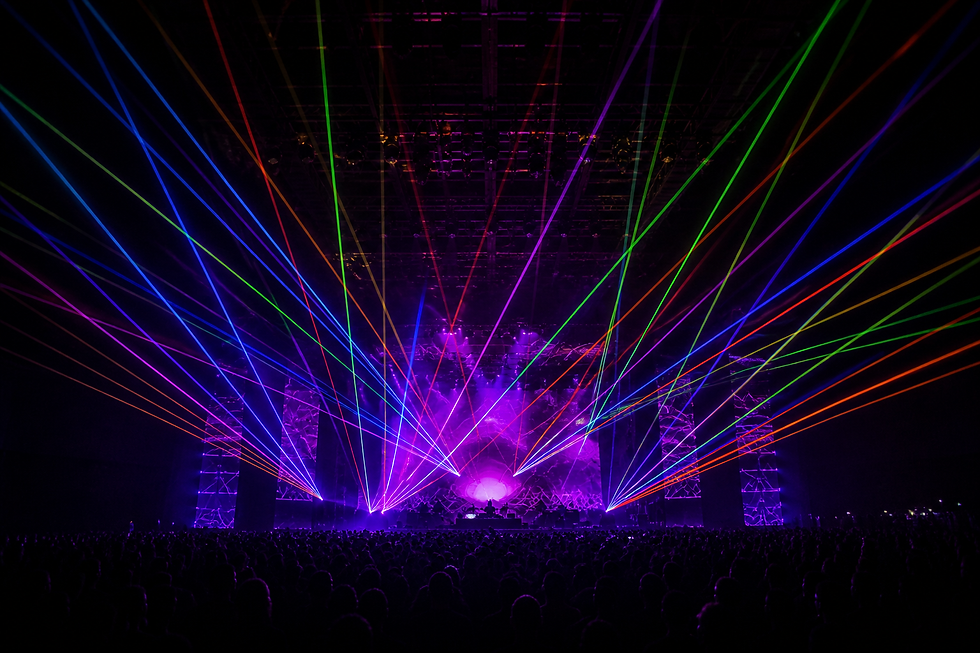
Documentation to Request
Venues should request and review the following documentation prior to approving any laser installation:
Health and Safety File
A complete safety file outlining the installation, responsibilities, and control measures
Project-Specific Risk Assessment
A documented assessment identifying potential risks and how they are mitigated
Site Plan and Beam Layout
A clear layout indicating laser positions, beam paths, projection areas, and control positions
Proof of Public Liability Cover
Confirmation that appropriate insurance is in place for the installation
Regulatory Submission Confirmation
Evidence that the required application has been submitted to SAHPRA for Class 3B and Class 4 laser systems
Safety Oversight Confirmation
Details of the designated safety oversight person, including evidence of recognised competency
This confirms that the installation has been described and considered before load-in.
Onsite Confirmation
Before laser operation begins, the venue should confirm that:
A responsible operator is present and actively controlling the system
The operator has a clear and unobstructed view of the projection area
A designated Laser Safety Officer is on site. LSASA recognises ILDA-accredited Laser Safety Officers as the accepted standard for this role
An interlock system is in place, including an accessible emergency stop (E-stop) and key-controlled lockout
Beam paths are fully contained within defined areas and do not enter any accessible spaces
No audience exposure is permitted. Laser beams must not interact with any person at any time
Minimum separation distances are maintained, including vertical and lateral clearances
Physical hard masking is installed to enforce beam limits and prevent unintended exposure
All CCTV cameras, video cameras, and photographic equipment are positioned outside of any defined beam path and protected from direct exposure
The installation matches the approved site plan and submitted documentation
If the installation differs from what was described, or if any of these conditions are unclear, clarification must be obtained before operation proceeds.
